Implementing AI Voice Screening Across Languages and ATS: A Practical Checklist
By Tanisha ·

AI voice screening replaces the first-round phone call with a structured interview that candidates complete on their own schedule. The platform screens CVs, runs the voice conversation, scores every answer against a fixed rubric, and returns a ranked shortlist. No scheduling, no phone tag, no inconsistent notes from one recruiter to the next. The checklist below covers exactly how to configure this end to end: from writing your role requirements once to reading a scored transcript on the other side. We draw on RoundOne AI throughout as our working example, because it covers the full workflow this article describes.
If you're evaluating an AI screening software solution for a high-volume team, this guide gives you the platform comparison data, implementation steps, and compliance checklist you need to move from evaluation to production.
Key takeaways
- One requirements doc drives everything: The role brief you write once powers CV filtering, the voice interview question set, and the scoring rubric, no per-candidate configuration needed.
- Speed is real but specific: Benchmarks show 50–80% lower screening time and 12–22 recruiter-hours recovered per week; end-to-end time-to-hire improvements average 25–40%.
- Consistency is a risk management tool: Uniform questions and a fixed rubric structurally reduce bias from interviewer fatigue, halo effect, and accent preference.
- ATS integration depth matters: Read/write integration keeps your ATS as the system of record and eliminates double entry; read-only connections do not.
- Compliance stays with the employer: Vendor features reduce exposure but do not transfer legal liability for recording consent, accommodations, or adverse-action review.
- Rubrics need behavioral anchors: Four to six weighted competencies on a 1–5 scale are recommended over a single opaque AI score for both accuracy and defensibility.
What is AI voice screening, and how does it differ from what you're already doing?
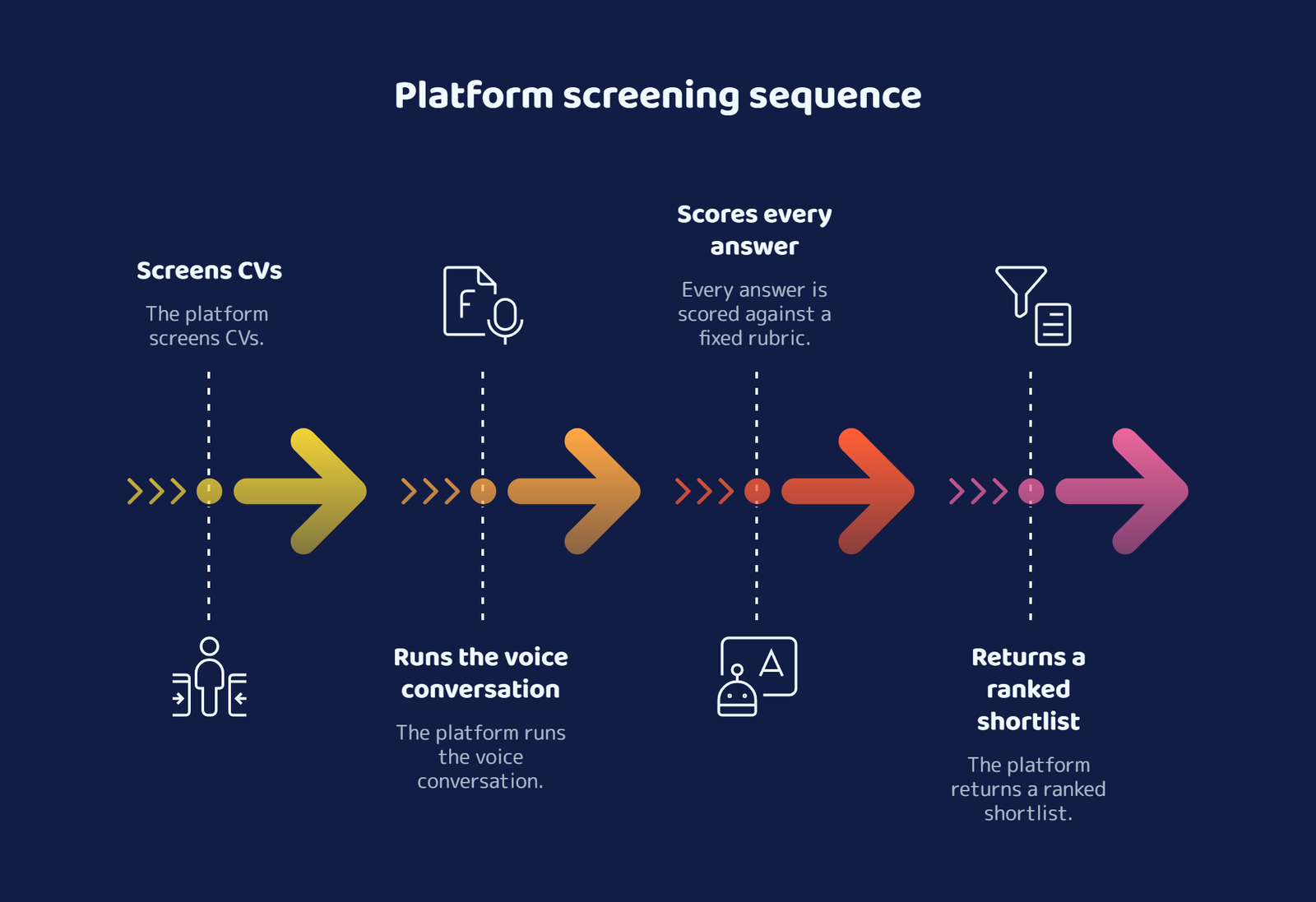
A conversational AI screening platform sends candidates a link, asks structured questions in natural spoken dialogue, transcribes the responses, and scores each answer against role-specific criteria you define in advance. The recruiter touches the output, not the call. That is a meaningfully different workflow from either an ATS chatbot or a robocall system, and the distinction matters when you're building an internal business case.
How it compares to manual phone screens
Manual screens have two structural failure modes: inconsistency and time cost. Each recruiter asks different questions, takes notes differently, and applies a personal judgment that varies by mood, familiarity with the role, and the last candidate they spoke with. In high-volume hiring, that inconsistency compounds fast. On top of that, a manual screen consumes approximately 20–25 minutes per candidate when you include scheduling, the call, and documentation. Commonly cited recruiter time studies put the conversation alone at 10–15 minutes, with coordination consuming another 5–10.
An automated voice interview runs asynchronously. The question set is identical for every candidate, and the scoring rubric applies the same weights. The recruiter reviews a scored transcript rather than relaying a live judgment from memory.
Why text-based chatbot screening isn't the same thing
Many ATS platforms include text chatbot screening, but typing imposes a literacy ceiling and strips out the natural signals of spoken communication. For roles involving customer calls, frontline communication, or spoken fluency in a second language, voice format is the more valid test of job-relevant skill. A voice interview, or AI phone interview, in practice, captures answer structure, fluency, and communication style that a checkbox sequence simply cannot.
What results can high-volume teams expect?
A defensible planning assumption for teams deploying a voice AI recruiter for first-stage qualification is 50–80% lower screening time and 12–22 recruiter-hours recovered per week. For end-to-end time-to-hire, the defensible benchmark range is 25–40% faster when scheduling and follow-up are automated alongside screening.
Speed is not the only return. Consistent scoring across every candidate in every market is itself a risk management tool. When a contact-center operator screens across five countries, uniform evaluation regardless of local office means the shortlist reflects job criteria, not whoever happened to pick up the phone that week.
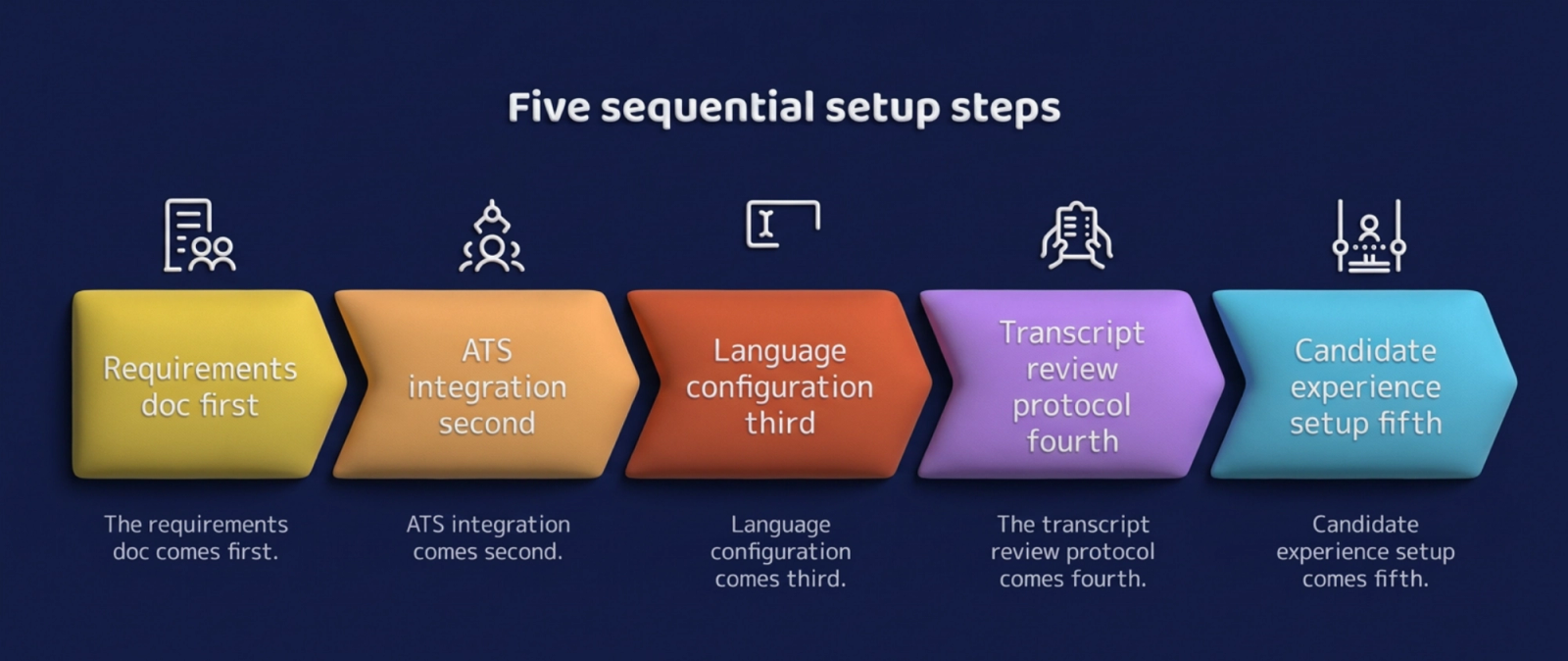
Your five-step implementation checklist
Step 1: Write your role requirements once and define your scoring rubric
The requirements document drives everything downstream: which CV signals matter, which questions the voice AI asks, and how each answer is scored. Use four to six weighted competencies, a 1–5 scale with behavioral anchors for each rating, and eligibility gates that auto-exclude candidates regardless of total score. A failed gate routes to human review, not automatic rejection. The recruiter writes this once per role, not per candidate.
Step 2: Connect your ATS and configure candidate routing
ATS integration in practice means the platform pulls applicants automatically when they reach a configured pipeline stage, runs screening, and pushes scored results back as a ranked shortlist on the candidate record. RoundOne AI connects with 30+ ATS platforms. During setup, check field mapping, trigger logic, and what a failed gate routes to. A read/write integration keeps your ATS as the system of record; a read-only connection does not write results back and forces manual data entry.
Step 3: Configure multilingual voice interviews
Select target languages per role before the first candidate enters the funnel. RoundOne AI screens candidates in 50+ languages, so a single requirements list covers a multilingual hiring geography without local recruiters for every market. Set realistic expectations on transcription reliability: word-error rate varies by language, accent, and audio quality, so testing representative recordings before launch is essential rather than optional.
Step 4: Read and act on scored transcripts correctly
A scored transcript shows each question, the candidate's response, a rubric score per dimension, a weighted composite, and a fraud/authenticity flag. Treat the composite as decision support, not an automatic decision. For borderline scores (typically 65–79 on a 100-point scale), advance only after recruiter review confirms the evidence. Any failed eligibility gate routes to human review regardless of total score. Document your override rationale every time you depart from the AI recommendation.
Step 5: Build the candidate experience before you go live
Disclose that the interview is AI-led in both the job posting and the invitation. Specify the duration, number of questions, required device permissions, and expected response timeline. Keep the interview to roughly 6–10 minutes of job-relevant questions. Provide a practice round before scored questions begin, offer a human or text-based alternative for candidates who need accommodation, and send a completion confirmation immediately with next-steps timing. Undisclosed AI, excessive length, and unclear next steps are the most common, and most avoidable, drop-off triggers.
What compliance and bias risks do you need to plan for?
Four exposure points demand attention before you launch an AI voice screening workflow:
- Recording consent: Two-party-consent state laws require clear disclosure before the call begins.
- Protected-trait inference: Voice may reveal or permit inference of age, disability, national origin, or gender even without intent, so scoring must be limited to transcribed answer content, not voice characteristics.
- Biometric obligations: Confirm with your vendor whether the platform creates a voiceprint, and obtain required consent where biometric privacy laws apply.
- Automated-decision regulation: NYC Local Law 144 requires qualifying tools to undergo an annual bias audit, and employment AI is treated as high risk under the EU AI Act framework.
Vendor compliance features reduce your exposure but do not transfer legal responsibility. The employer still owns job-related question design, accommodation processes for disabled candidates, demographic pass-through monitoring, human review before adverse decisions, and audit log retention. Apply a practical procurement threshold: decline any vendor that cannot show what data drives scoring, how candidates opt out or request accommodation, and how every recommendation can be reconstructed after the fact.
How do you choose the right AI voice screening platform?
Five criteria separate a production-ready platform from a demo that works in a quiet room. Start with ATS integration depth, read/write versus read-only, which determines whether results flow back automatically or require manual entry. Next, consider language coverage and transcription reliability for your specific hiring geography; that determines whether multilingual screening is real or theoretical.
Beyond those two, evaluate:
- Scoring transparency: Can a recruiter trace a score to a specific question and transcript excerpt?
- Fraud and authenticity checks: How much downstream verification work does your team carry?
- Pricing model fit: Does the structure match your actual volume?
| Platform | Best fit | Languages | Published pricing* |
|---|---|---|---|
| RoundOne AI | High-volume, frontline, multilingual, BPO, RPO | 50+ | Contact sales |
| HireVue | Enterprise skills-based hiring | Not specified | Custom quote |
*Pricing sourced from vendor pricing pages and third-party directories including HeroHunt and CloudTalk; verify current rates directly with each vendor before procurement.
Match your volume profile to a pricing structure before shortlisting. At low per-role volume, a per-screen model keeps costs variable. At sustained high volume, a monthly or enterprise model typically delivers a lower unit cost. For teams that need read/write ATS integration, branded screening, multilingual voice interviews, and fraud checks in a single workflow, RoundOne AI covers the full checklist described in this article: one requirements list per role and screening in the candidate's native language, with fraud flags already applied and results pushed back to your existing ATS.
Get your first AI voice screening workflow running this week
The five steps above are genuinely sequential: requirements doc first, ATS integration second, language configuration third, transcript review protocol fourth, and candidate experience setup fifth. Skipping the rubric step and trusting an opaque composite score is the most common implementation mistake, and it creates both compliance exposure and poor shortlist quality. Write behavioral anchors for every rating before the first candidate enters the funnel.
ATS integration should be tested on a live role before you scale. Verify that scored results write back to the candidate record correctly, that field mapping matches your workflow stages, and that borderline candidates route to human review rather than auto-rejection. Build the human oversight step in from the start, not after a compliance complaint surfaces.
RoundOne AI is built around the workflow described in this guide. If you're ready to map your current hiring stack to an AI voice screening setup, contact RoundOne AI directly to walk through ATS configuration, language requirements, and role setup.